
Attic Insulation What It Really Costs: What Moreno Valley Homeowners Pay in 2026
Attic insulation in Moreno Valley runs roughly $1.50 to $7.50 per square foot installed in 2026, depending on material and scope. A typical 1,400 square foot attic lands between $2,100 and $7,000 for a full job. But here’s the thing: two contractors can quote the same attic and come in 40 – 60% apart for reasons that have almost nothing to do with the insulation itself. We’ll break down exactly what sits behind those gaps so you can compare quotes line by line instead of guessing. If you’d rather skip the homework and have us walk your attic with you, call (844) 241-0737 for a free estimate.
Why Two Moreno Valley Quotes for the Same Attic Can Be $900 Apart
Here’s the scenario we see all the time. A homeowner in Moreno Valley gets three bids for a 1,400 square foot attic. The first quote is $1,400. The second is $2,300. The third is $2,800. Same house. Same square footage. So what gives?
Rarely is the spread explained by greed or markup. It’s scope. The $1,400 quote probably includes blowing fiberglass over the existing insulation and calling it a day. The $2,300 quote includes removing the old, compacted material, air sealing penetrations, and sealing the attic hatch. The $2,800 quote adds HVAC boot sealing and baffle installation in every rafter bay. None of these contractors are lying to you. They’re just not all solving the same problem.
In our experience pricing attics across Moreno Valley, the homes in neighborhoods like Sunnymead Ranch and Rancho Belago tend to have older, thinner insulation from the 1980s and 1990s that needs to come out before anything new goes in. Newer subdivisions around the eastern edge of the city may only need a top-up. When you’re comparing quotes, ask each contractor to list exactly what’s included: removal or not, air sealing or not, baffles or not. That’s the conversation that turns confusion into clarity.
2026 Per-Square-Foot Prices by Material in Moreno Valley
Let’s put real numbers on the table. These are the installed price ranges we see in the Moreno Valley market this year, including labor, material, and haul-away where noted. Prices assume a standard vented attic with accessible joists and no major obstructions.
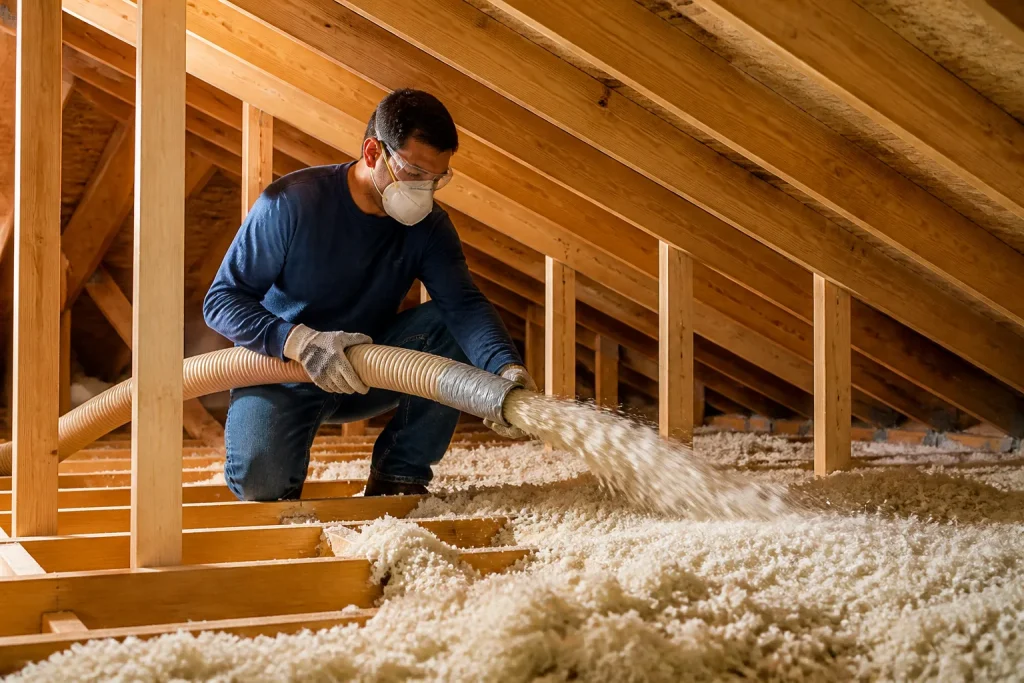
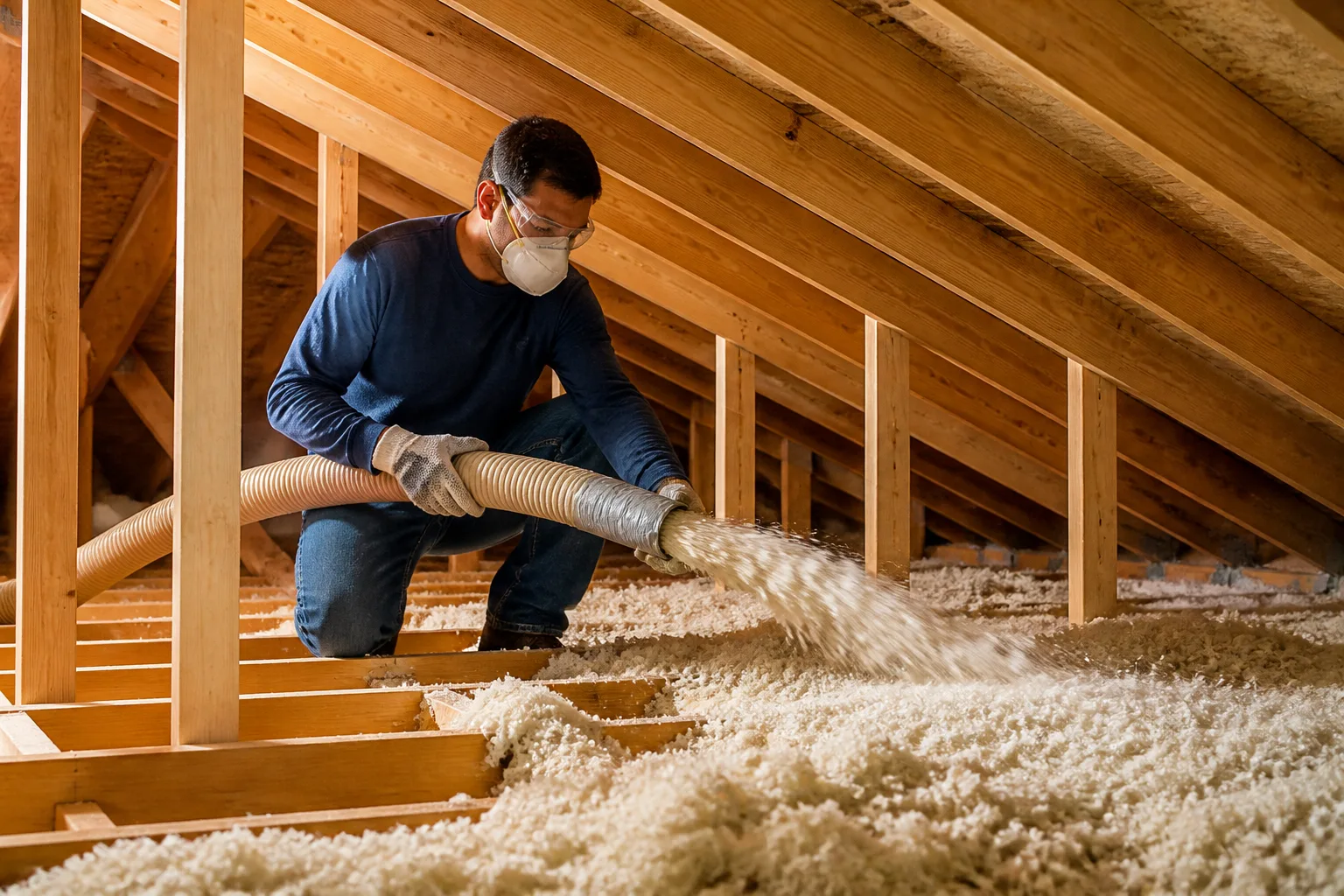
- Blown fiberglass (open blow over existing insulation): $1.50 – $2.50 per sq ft. The most common budget option. Fast to install. Works fine when the existing insulation is dry and intact. We typically reach for Knauf or CertainTeed blown fiberglass depending on the R-value target and existing conditions.
- Blown cellulose (GreenFiber or similar): $1.75 – $3.00 per sq ft. Slightly denser than fiberglass, better at blocking airflow, and made primarily from recycled paper. A strong option for Moreno Valley homeowners who want environmental performance without spray foam pricing.
- Fiberglass batt (new install in open joist bays): $2.00 – $4.00 per sq ft. More common in new construction or when the attic is being finished. Batts need to be cut precisely around wiring and fixtures, which is where labor creeps up.
- Open-cell spray foam (roofline application, cathedral ceilings, or enclosed attic): $3.50 – $5.50 per sq ft of applied area. Seals and insulates in one pass. Worth considering for attics with HVAC equipment in the space, which is common in Moreno Valley’s older homes where the furnace sits up there.
- Closed-cell spray foam: $5.50 – $7.50 per sq ft. Higher R-value per inch and works as a vapor barrier. We work with Icynene and Demilec systems when the home calls for it, but closed-cell is rarely the right first choice for a standard vented attic with no moisture issues.
One material worth flagging: Rockwool mineral wool. It runs $3.00 – $5.00 per sq ft installed, and most insulation contractors in Moreno Valley don’t stock it at all. It’s fire-rated, moisture-tolerant, and noticeably better at sound control than fiberglass or cellulose. If you have a home office below the attic or a sunroom with unusual heat gain, mineral wool deserves a serious look.
The Hidden Line Items That Inflate Moreno Valley Attic Quotes
This is where the quote gap lives. When we break down a job for a homeowner, these are the line items that turn a simple insulation install into something more involved. None of them are made up. All of them matter. And most contractors won’t volunteer them unless you ask.
- Old insulation removal and haul-away: $0.75 – $1.50 per sq ft. If the existing insulation is damp, rodent-damaged, or compressed to half its original R-value, it needs to come out. That’s labor, bags, a vacuum truck, and dump fees. Skipping this step when it’s needed means the new insulation sits on top of a compromised base layer.
- Air sealing: $400 – $900 for a standard attic. Caulk, foam, and labor to seal top plates, wiring penetrations, plumbing vents, and recessed light housings. Air sealing is the difference between insulation that performs and insulation that’s just decorative. The U.S. Department of Energy consistently lists air sealing before insulation in its attic retrofit recommendations, and for good reason.
- Attic hatch sealing and insulation: $75 – $200. A surprising number of Moreno Valley homes have a piece of raw plywood over a stair opening with no insulation whatsoever. It’s a hole in your thermal envelope. Literally.
- HVAC boot and duct sealing: $200 – $500. When the furnace or air handler lives in the attic, which is common in ranches and older track homes throughout Moreno Valley, every leaky duct joint is pumping conditioned air into a 130°F attic in August. Sealing those boots is some of the cheapest comfort money you’ll spend.
- Baffles and venting corrections: $150 – $400. Rafter baffles keep soffit vents clear so air can move. Homes with existing baffle issues or shallow eaves often need them installed before insulation gets blown in.
- Permit fees: $100 – $300 in Riverside County depending on scope. Not every insulation job requires one, but any work that changes the structure or ventilation layout typically does. Make sure your contractor is pulling permits where required.
- Access and complexity: $150 – $800. If your attic has a narrow scuttle hole, deep blown insulation already in place, or framing that makes it hard to move around, that’s labor time. The material cost doesn’t change. The hours do.
Here’s the honest math. Two quotes for a 1,400 square foot attic in Moreno Valley. One covers “blow more insulation on top” at $1,400. The other includes removal of 40-year-old material, air sealing every penetration, sealing the hatch, and installing baffles. If the price on the second quote is $2,400, that’s not a contractor overcharging. That’s the first contractor leaving $1,000 worth of necessary work off the bid. The only way to know which you’re looking at is to compare the line items.
How Attic Configuration Affects Labor Cost in Moreno Valley Homes
Labor drives most of what you’ll pay, and labor is driven by attic geometry. Moreno Valley’s housing stock runs the gamut: mid-century ranches with low-pitch roofs, two-story colonials in the hills, newer tract homes with truss systems, and custom homes with complex roof lines. Each one prices differently.
Low-pitch roofs and shallow attics. Many Moreno Valley ranches built in the 1960s and 1970s have shallow attic spaces with limited headroom. Crawling through them to install insulation takes longer, plain and simple. Labor costs run 30 – 50% higher than a standard attic with standing room.
Truss attics with tight webs. Newer homes often use engineered trusses with webbing that makes movement difficult. Getting blown insulation into the far corners means reaching through awkward framing. It’s doable, but it’s slow.
HVAC equipment in the attic. When the air handler or ductwork sits in the attic, technicians have to work around it. That means more time on site, and it also means sealing duct boots becomes part of the job if you want actual performance. Homes in Moreno Valley with attic HVAC systems are the norm more than the exception in the older neighborhoods.
Knee walls and finished attic spaces. If part of the attic is finished or has knee walls, those vertical surfaces need insulation too, often batt or spray foam instead of blown material. That’s a whole different installation method on the same job, and it changes the material math.
Existing obstacles and hazards. Old wiring, vermiculite, recessed lights that aren’t IC-rated, and roof leaks all pause the job. A thorough contractor checks for these before quoting. A cheap quote often means nobody looked.
When we walk an attic in Moreno Valley, we’re not just measuring square footage. We’re looking at how we’ll physically move through the space, where the baffles go, what needs sealing, and whether the existing material is even worth keeping. Those details change the work more than any material choice will.
Stacking SCE and SoCalGas Rebates with the Federal 25C Tax Credit in 2026
If you’re insulating an attic in Moreno Valley this year, there’s a real chance you can knock 30% or more off the project cost through a combination of utility rebates and federal tax credits. The key is documentation.
Southern California Edison and SoCalGas both offer residential energy-efficiency rebates that apply to attic insulation work when paired with air sealing or duct sealing. SCE’s rebates are tied to demand-reduction programs and apply to attic insulation when a home has existing electric cooling. SoCalGas offers insulation and air-sealing rebates through its Home Energy Efficiency Rebate program, with higher amounts available when the home has gas heating. The exact rebate amounts change annually, and the 2026 numbers are set by program administrators based on verified savings.
The federal 25C tax credit is the bigger piece. For 2026, the credit covers 30% of qualifying insulation and air-sealing material costs, with a $1,200 annual cap for insulation and air sealing combined. Labor is not included in the 25C calculation. The credit applies to materials that meet current IECC standards, and you’ll need an itemized invoice that separates material costs from labor to claim it accurately.
What your installer must provide for you to claim these:
- An itemized invoice separating materials from labor for the 25C credit.
- Manufacturer product spec sheets showing R-value and material type, so you can document compliance with 2021 IECC standards.
- A signed statement of work confirming the insulation was installed in a primary residence.
- For utility rebates, the contractor usually submits on your behalf through the program portal. Ask before you sign whether they handle the paperwork.
One caution: rebates and credits don’t stack automatically. SCE and SoCalGas rebates can generally be combined with the federal 25C credit since they’re separate programs with separate eligibility rules. But the utility rebate may reduce the amount you can claim as a 25C credit in some situations, so it’s worth a conversation with a tax preparer who understands energy credits. The IRS requirements are specific, and an audit over an insulation credit is a headache nobody in Moreno Valley needs.
The Real Cost of Skipping Air Sealing the First Time
We pulled an attic job in a 1990s home over in Moreno Valley Ranch last year where the homeowner had paid $1,100 for blown fiberglass just four years earlier. The contractor did exactly what was quoted: blew fresh insulation over the old stuff. No air sealing. No removal. No hatch work. The homeowner called us because their upstairs bedroom was still hitting 82°F in July and the summer electric bill had barely budged.
When we opened the attic, the new insulation was fine. R-38 of settled, dry fiberglass. The problem was everywhere the insulation wasn’t: the holes around wiring runs, the chimney chase, the bathroom exhaust fans venting straight into the attic, the unsealed hatch. Warm air was flowing through those gaps like the insulation wasn’t there. Air moves through insulation by convection unless the gaps are sealed first.
That job cost the homeowner $1,100 the first time, then another $2,300 to do it right the second time, including removal of the four-year-old material in areas where we had to access the framing to seal properly. The cost of doing it wrong was doing it twice. We see this pattern frequently across Moreno Valley, where hot attic air and duct leakage combine to undermine insulation performance before the material is even a year old.
The lesson: air sealing is not an add-on. It’s the foundation. Insulation slows heat transfer. Air sealing stops air movement. Your attic needs both, especially in a climate where August temperatures routinely pass 100°F and your air conditioner is fighting the attic all day.
When to call a pro: If your attic has old or unknown insulation material, vermiculite (which may contain asbestos), signs of rodent activity, or you can see daylight around vents and penetrations, get a professional inspection before anyone blows new material. In those situations, the inspection is the most valuable line item on the quote. The team at Snug Insulation walks every attic before quoting, and we’ll show you what we’re seeing up there, good or bad.
Related services in Moreno Valley: We cover the full insulation picture locally. Attic insulation in Moreno Valley is our core service, but we also install spray foam insulation for enclosed attics and challenging rooflines, and blown in insulation when open-blow is the right fit for the space. Each method has a place depending on the attic configuration and your goals.
The Bottom Line
Attic insulation in Moreno Valley in 2026 costs between $1.50 and $7.50 per square foot installed, with most standard attic retrofits landing in the $2,000 to $5,000 range. The spread comes down to scope, not markup: whether the quote includes removal, air sealing, hatch work, baffles, and HVAC boot sealing. A lower bid that skips those steps will cost you more in the long run, especially in a climate like Moreno Valley’s where attic temperatures swing hard.
Stack the SCE or SoCalGas rebate with the federal 25C credit and you can meaningfully offset the cost of doing the job correctly the first time. Just make sure your contractor provides itemized documentation, and ask about air sealing before you sign anything.
If you’re in Moreno Valley and want a straightforward line-by-line estimate for your attic, Snug Insulation offers free walkthroughs and honest recommendations based on what your attic actually needs, not what we’re trying to move off the truck. Call (844) 241-0737 to schedule yours.
Frequently Asked Questions
Most attic insulation projects in Moreno Valley run $2,000 to $5,000 for a typical 1,400 square foot attic, or $1.50 to $7.50 per square foot depending on material choice, removal, and air sealing scope. Blown fiberglass starts at the low end; closed-cell spray foam sits at the top. Call (844) 241-0737 for an exact quote on your attic, which is free and includes a full walkthrough.
For blown-in insulation, renting a machine and buying material typically runs $800 to $1,200 for a 1,400 square foot attic, plus your time, versus $2,100 to $3,500 for professional installation with air sealing. The difference is that professionals include sealing, safety equipment, and material handling expertise. For spray foam, absolutely hire a professional. Improperly mixed foam off-gasses and underperforms. Call (844) 241-0737 if you want to compare our line items against the DIY math.
Removal and haul-away of old attic insulation runs $0.75 to $1.50 per square foot, so a 1,400 square foot attic removal adds roughly $1,050 to $2,100 to the project. This line item matters when existing material is damp, rodent-damaged, or significantly compressed. We always evaluate whether removal is actually necessary before recommending it. Call (844) 241-0737 for an honest assessment of your attic’s existing material.
Simple insulation installation over existing material usually doesn’t require a permit in Moreno Valley. But if the scope includes structural modifications, ventilation changes, or spray foam on the roofline, a permit from the City of Moreno Valley or Riverside County is often required. Your contractor should know the local requirements and handle the paperwork. Call (844) 241-0737 and we’ll tell you whether your specific project needs one.
Written by the team at Snug Insulation, serving Moreno Valley since 2016.
Need Insulation Help?
Call Snug Insulation — licensed & insured, here with fast after-hours help in Moreno Valley.
(844) 241-0737