
Rockwool Attic Insulation in Moreno Valley: A Homeowner’s Guide
Rockwool attic insulation in Moreno Valley typically costs $1.90 to $2.80 per square foot installed, running about 30 to 50 percent more than blown cellulose or fiberglass for the same R-value. That premium buys you real fire resistance, better sound dampening, and dimensional stability that other materials can’t match. If you’d rather skip the research and get a straight answer on what your attic actually needs, call (844) 241-0737 for a free estimate.
Here’s the thing most insulation guides won’t tell you: Rockwool is genuinely the right call for certain Moreno Valley attics, but it gets oversold as a universal upgrade. In a standard flat-ceiling attic with deep joist bays, blown cellulose from GreenFiber or fiberglass from Owens Corning delivers the same thermal performance for noticeably less money. The real question isn’t is Rockwool good? It’s does your attic have the specific conditions where Rockwool earns its cost?
What Makes Rockwool Different From Other Attic Insulation
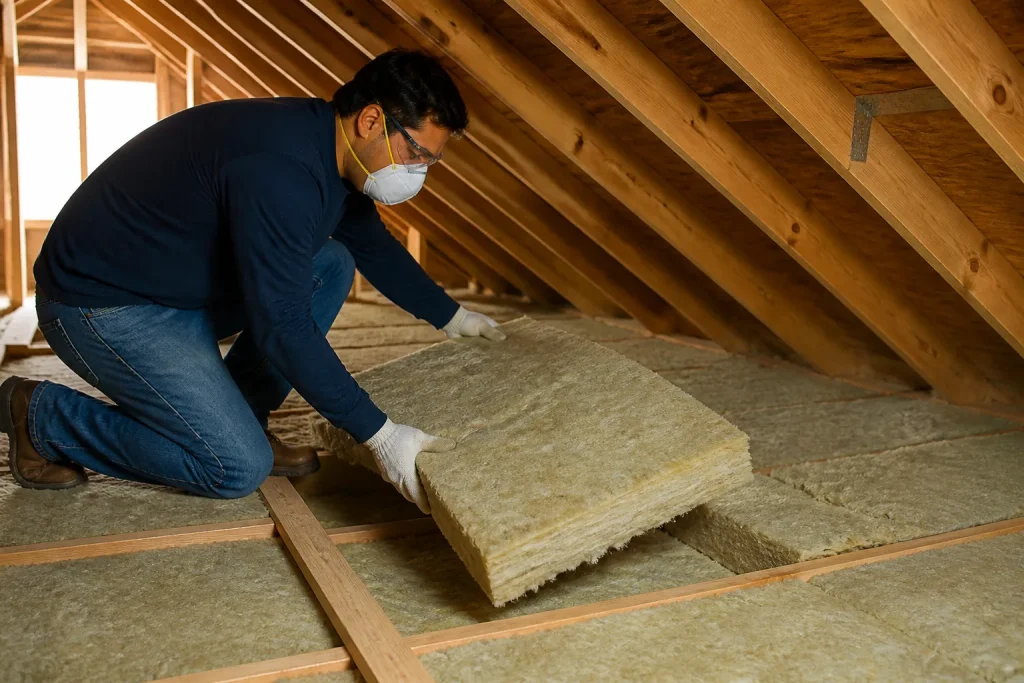
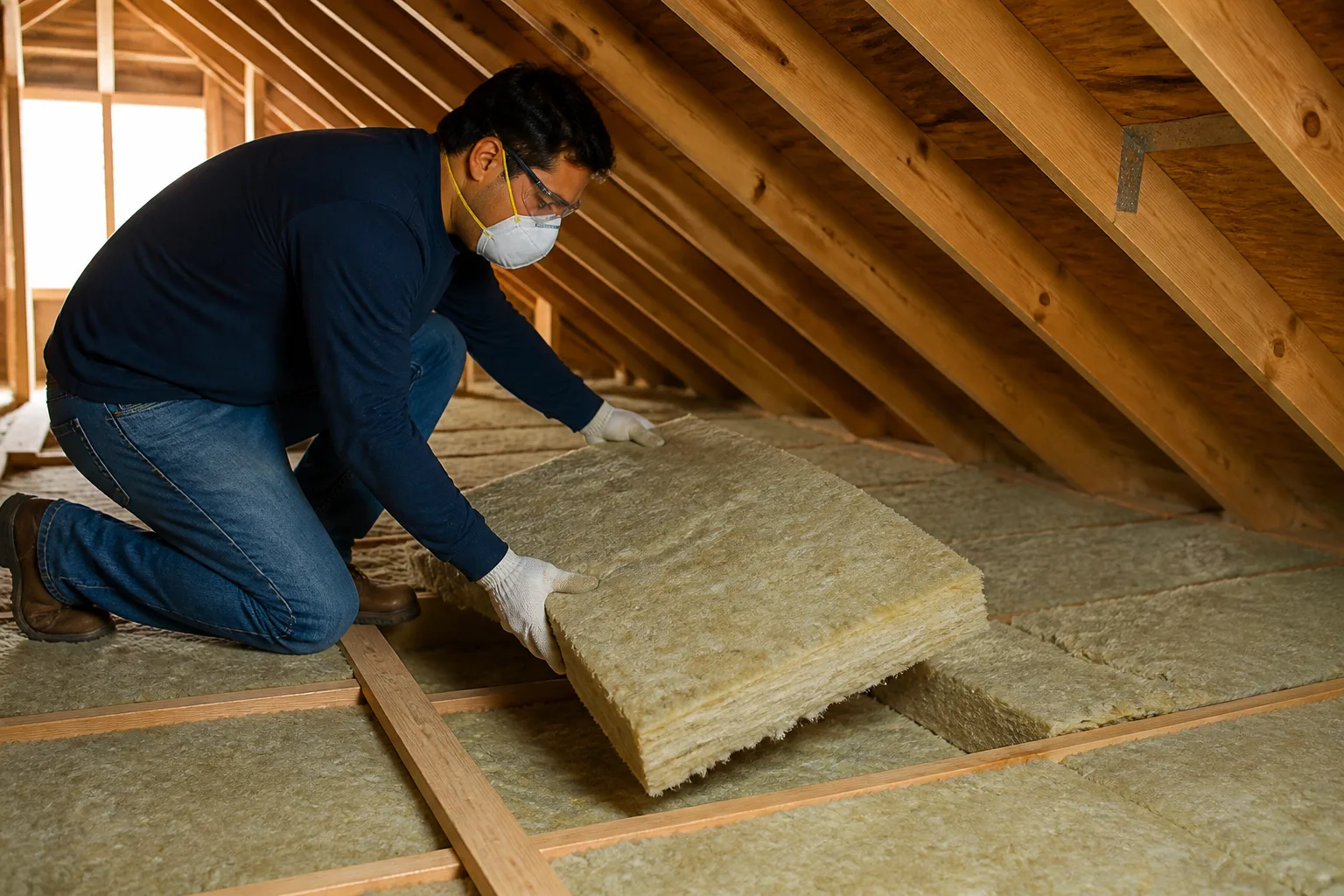
Rockwool is mineral wool, made by spinning molten basalt rock and recycled slag into dense fibers. The result is a semi-rigid batt that holds its shape, shrugs off moisture, and won’t ignite. Those three properties drive every smart decision about where to use it in a Moreno Valley attic.
Fiberglass batts from Johns Manville or Knauf compress when you pack them into tight spaces, and compressed fiberglass loses R-value fast. Blown cellulose settles over time, especially in sloped cavities where gravity works against you. Rockwool’s density means it stays put at its rated thickness for decades. In Moreno Valley homes built in the 1980s and 1990s with shallow rafter bays over bonus rooms or cathedral ceilings, that dimensional stability is the difference between insulation that works on day one and insulation that works on day one and still works on year fifteen.
We stock Rockwool because some attics need exactly what it does. We also stock GreenFiber, Owens Corning, Johns Manville, and Knauf because most attics don’t. Material choice should follow the attic’s geometry and the homeowner’s priorities, not the contractor’s warehouse inventory.
Fire Resistance: Where Rockwool’s Rating Actually Matters
Rockwool is non-combustible. It carries a fire rating that fiberglass and cellulose simply don’t have. In Moreno Valley, where Santa Ana winds push embers into eaves and attic vents every fire season, that sounds essential. And sometimes it is.
But fire resistance only protects your home where the fire reaches first. If your attic has recessed light fixtures, Rockwool batts make sense around them. Standard can lights generate heat, and even IC-rated fixtures get warm enough to degrade cellulose dust over time. Rockwool can sit directly against non-IC-rated housings without scorching, because the rock fibers won’t burn. In our experience, Moreno Valley homes from the 2000s builder boom often have six to twelve recessed lights in the ceiling below the attic, and the insulation around those fixtures is where we see the most heat-related settling and discoloration.
The second fire-relevant scenario is the attic perimeter near the eaves. Embers that blow into vented soffits land on whatever insulation is closest. Cellulose is treated with fire retardant, but it’s still paper-based. Fiberglass won’t ignite, but it melts at high temperatures and leaves gaps. Rockwool just sits there, inert. If your Moreno Valley home is in a wildfire-adjacent zone near Box Springs Mountain or the eastern foothills, the upgrade is worth considering for the eave line specifically, even if the rest of the attic gets a blown product.
The Three Moreno Valley Scenarios Where Rockwool Earns Its Premium
We’ve installed Rockwool in attics all over Moreno Valley, from Rancho Belago to Sunnymead Ranch. After years of watching how different materials perform, three situations consistently justify the cost.
- Sloped rafter bays and cathedral ceilings. Blown insulation can’t maintain consistent coverage on a slope. It piles at the bottom and thins at the peak. Rockwool batts friction-fit between rafters and stay at full R-value indefinitely. If your Moreno Valley home has a vaulted family room ceiling or attic bonus space, this is the strongest case for Rockwool.
- Recessed lights and heat-producing equipment. As mentioned, Rockwool’s non-combustible rating means it can sit against hot fixtures without degrading. If your attic has a furnace, ductwork, or a dozen can lights, Rockwool around those specific zones prevents the slow settling and scorching that plague fiberglass and cellulose.
- Sound control between living space and attic. Rockwool’s density blocks sound better than any other batt material. In Moreno Valley homes with attic bedrooms or bonus rooms over garages, Rockwool between the floor joists kills the echo and the noise transfer that makes those rooms uncomfortable.
Outside those three scenarios, in a standard open attic with deep joist bays and no heat sources, blown cellulose from GreenFiber delivers the same effective R-value at roughly 60 percent of the cost. We tell homeowners this because the right material for the application matters more than the premium name on the bag.
R-Value Reality: Rockwool vs. Fiberglass vs. Cellulose in Moreno Valley Attics
At equal installed thickness, the R-values are closer than most marketing suggests. Rockwool batts deliver R-4.2 to R-4.3 per inch. High-density fiberglass batts from Owens Corning or Knauf deliver R-3.7 to R-4.3 per inch depending on the product line. Blown cellulose from GreenFiber delivers R-3.4 to R-3.8 per inch.
In a standard Moreno Valley attic, the Department of Energy recommends R-38 to R-60 for this climate zone. That means 10 to 14 inches of blown cellulose, 10 to 12 inches of blown fiberglass, or 9 to 14 inches of Rockwool, depending on the product. The performance gap between Rockwool and dense-packed cellulose at recommended attic depths is roughly 5 to 8 percent in real-world conditions. That gap shrinks further when you account for the fact that cellulose fills around framing members and Rockwool batts can’t.
The honest take: if you have a flat attic with room for deep insulation, you won’t notice the difference between R-49 Rockwool and R-49 cellulose on your energy bill. You’ll notice the difference in the invoice. Rockwool costs substantially more per installed R-value, and the thermal benefit in a standard attic doesn’t justify it.
Where Rockwool wins on R-value is in constrained spaces. If your Moreno Valley attic has shallow 2×6 joist bays, you can only fit so much material. Rockwool’s higher R-value per inch means you get R-23 in a 2×6 cavity where standard fiberglass batts deliver R-19. That’s a 20 percent improvement in a space where every inch matters.
Moisture Behavior: Why Rockwool’s Hydrophobic Advantage Matters Less Here
Rockwool repels water. Its fibers don’t absorb moisture, and the material maintains its R-value even in humid conditions. That’s a genuine advantage in coastal markets like San Diego or Orange County, where marine-layer humidity creeps into attics and condenses on the underside of roof decking.
Moreno Valley doesn’t have that problem. Our humidity rarely breaks 50 percent, and summer attics in Moreno Valley hit 140 degrees, baking moisture out before it can accumulate. The moisture-tolerance advantage that makes Rockwool worth the premium in Santa Monica or Huntington Beach barely matters here. If your attic stays dry, and most Moreno Valley attics do, paying extra for hydrophobic properties is paying for a problem you don’t have.
The one exception is around HVAC equipment. Air handlers and ductwork in unconditioned attics sweat during summer. That condensation drips into the insulation below. Rockwool around the air handler stays uncompromised. Fiberglass mats down. Cellulose absorbs and settles. If your Moreno Valley attic has the furnace and air handler up there, a Rockwool section around the equipment is a cheap insurance policy against insulation degradation.
What Rockwool Attic Insulation Costs in Moreno Valley
For a typical 1,200-square-foot attic in Moreno Valley, expect to pay $2,300 to $3,400 for full Rockwool coverage. The same attic with blown cellulose runs $900 to $1,500. With blown fiberglass, $1,100 to $1,800. The premium is real, and it doesn’t pay itself back on energy savings alone.
Let’s do the honest math. The energy savings difference between R-49 Rockwool and R-49 cellulose in a Moreno Valley attic is maybe $20 to $40 per year on a typical electric bill. The installed cost difference is $1,400 to $1,900. The payback period on choosing Rockwool for thermal performance alone stretches past 40 years. That’s longer than most people stay in a home.
Rockwool makes financial sense when you’re buying the non-thermal benefits: fire resistance around eaves and fixtures, sound dampening in attic bedrooms, or dimensional stability in sloped cavities you never want to touch again. In those cases, the added cost isn’t an energy investment. It’s a durability and safety investment.
When to Call a Pro Instead of DIY
Installing Rockwool batts sounds straightforward: cut to width, press into place, move on. And for a small section, it is. But attic work in Moreno Valley summer heat is no joke. Attic temperatures hit 140 degrees by noon from June through September, and heat exhaustion comes on fast. Beyond the heat, there’s the safety side: working around recessed lights, HVAC equipment, and exposed wiring requires knowing what you can and can’t touch. Rockwool is non-combustible, but your house’s wiring is not. If you’re adding insulation around recessed fixtures, get it wrong and you’ve created a fire hazard where none existed before. We recommend a trained professional for any attic insulation work that involves electrical fixtures or sloped cavities.
If you’re in Moreno Valley and want a straight answer on whether Rockwool is right for your attic, call (844) 241-0737. We’ll walk the attic with you, show you what’s there, and tell you honestly if the premium material is worth it for your specific house.
Related Services in Moreno Valley
Rockwool is one option among several we install. See our attic insulation services in Moreno Valley for the full range of materials. If you’re building an addition or finishing a bonus room, spray foam insulation in Moreno Valley seals and insulates in one step. For standard attic retrofits where budget matters, blown-in insulation in Moreno Valley offers the best cost per R-value. And if you’re not sure which direction to go, start with Snug Insulation home for an overview of how we match materials to attics.
What happens when you call
- 1
A real person answersNo phone trees — you reach a local pro.
- 2
You get an upfront price rangeHonest numbers before anyone is dispatched.
- 3
A background-checked tech heads outLicensed & insured, dispatched right away.
- 4
You approve before work beginsNothing starts until you say go.
The Bottom Line
Rockwool attic insulation in Moreno Valley is the right choice for attics with sloped rafter bays, recessed lights, heat-producing equipment, or specific fire-risk zones near the eaves. In those situations, the fire resistance, dimensional stability, and density justify the 30 to 50 percent cost premium. For standard flat attics with deep joist bays and no heat sources, blown cellulose from GreenFiber delivers the same effective R-value at roughly 60 percent of the cost, and we’d tell you that even though we stock both.
If you’re in Moreno Valley and want an honest recommendation for your specific attic, Snug Insulation offers free estimates. We’ll look at your attic’s geometry, your existing insulation, and your priorities, then recommend the material that actually fits. Call (844) 241-0737.
Frequently Asked Questions
Rockwool is worth the premium if your attic has sloped rafter bays, recessed lights, HVAC equipment, or sits in a wildfire-adjacent zone where ember intrusion is a real risk. In a standard flat attic with deep joist bays, blown cellulose delivers comparable thermal performance for about 60 percent of the installed cost. Call (844) 241-0737 for an honest assessment of your specific attic.
A typical 1,200-square-foot Moreno Valley attic costs $2,300 to $3,400 for full Rockwool coverage, compared to $900 to $1,500 for blown cellulose or $1,100 to $1,800 for blown fiberglass. The premium reflects Rockwool’s fire rating, density, and dimensional stability. Call (844) 241-0737 for an exact quote, estimates are free.
Rockwool performs comparably to other insulation materials at the same R-value, so it reduces attic heat transfer about as well as blown cellulose or fiberglass. The difference is that Rockwool maintains its R-value over time in sloped cavities and around heat-producing fixtures, where other materials settle or degrade. For maximum thermal performance in a standard attic, depth matters more than material choice.
Rockwool batts can be laid over existing insulation if the existing material is in decent shape and isn’t holding moisture. However, the batts must sit directly on the drywall or existing insulation without gaps, and areas around recessed lights need proper clearance or non-combustible barriers. In most Moreno Valley retrofits, we typically recommend removing compromised existing insulation first, then installing the full system. Call (844) 241-0737 and we’ll check what’s already up there before recommending an approach.
Written by the team at Snug Insulation, serving Moreno Valley since 2016.
Need Insulation Help?
Call Snug Insulation — licensed & insured, here with fast after-hours help in Moreno Valley.
(844) 241-0737