Fast, Reliable Attic Insulation Across Yucca Valley
Attic insulation in Yucca Valley typically costs $1,800 – $4,200 for a full upgrade and most jobs are completed in a single day. The number depends on square footage, what’s currently up there, and whether you need air sealing or a radiant barrier added. We work throughout 92284 and 92286, from the older tracts off Highway 62 to the newer custom homes on larger lots. Call (844) 241-0737 for a free estimate and we’ll give you an honest read on what your attic actually needs.
If your cooling bills spike every summer and your heater can’t keep up on winter nights, the answer is almost always in the attic. Yucca Valley’s high-desert climate punishes under-insulated homes. We see it every week. The good news: the fix is straightforward, and the payoff shows up on your first utility bill.
Why Snug Insulation Is Yucca Valley’s Preferred Attic Insulation Company
Most insulation contractors treat the attic as a quick job between roofing projects. We don’t. Insulation is the only thing we do. Noel Castaneda, our owner, built Snug around one idea: the right material, matched to the right house, installed the right way. That’s why we carry insulation from Johns Manville, Rockwool, CertainTeed, and Knauf instead of whatever our supplier has on sale.
Homeowners in Yucca Valley call us because we understand what the Morongo Basin does to a house. The temperature swings here are brutal. A home that’s comfortable at noon can be freezing by 9 p.m. When we inspect an attic near Joshua Tree or up in the Western Hills, we know exactly what to look for: settled blow-in, missing baffles, ductwork baking under a dark roof, and air leaks around top plates and recessed lights. That local knowledge means we diagnose accurately the first time.
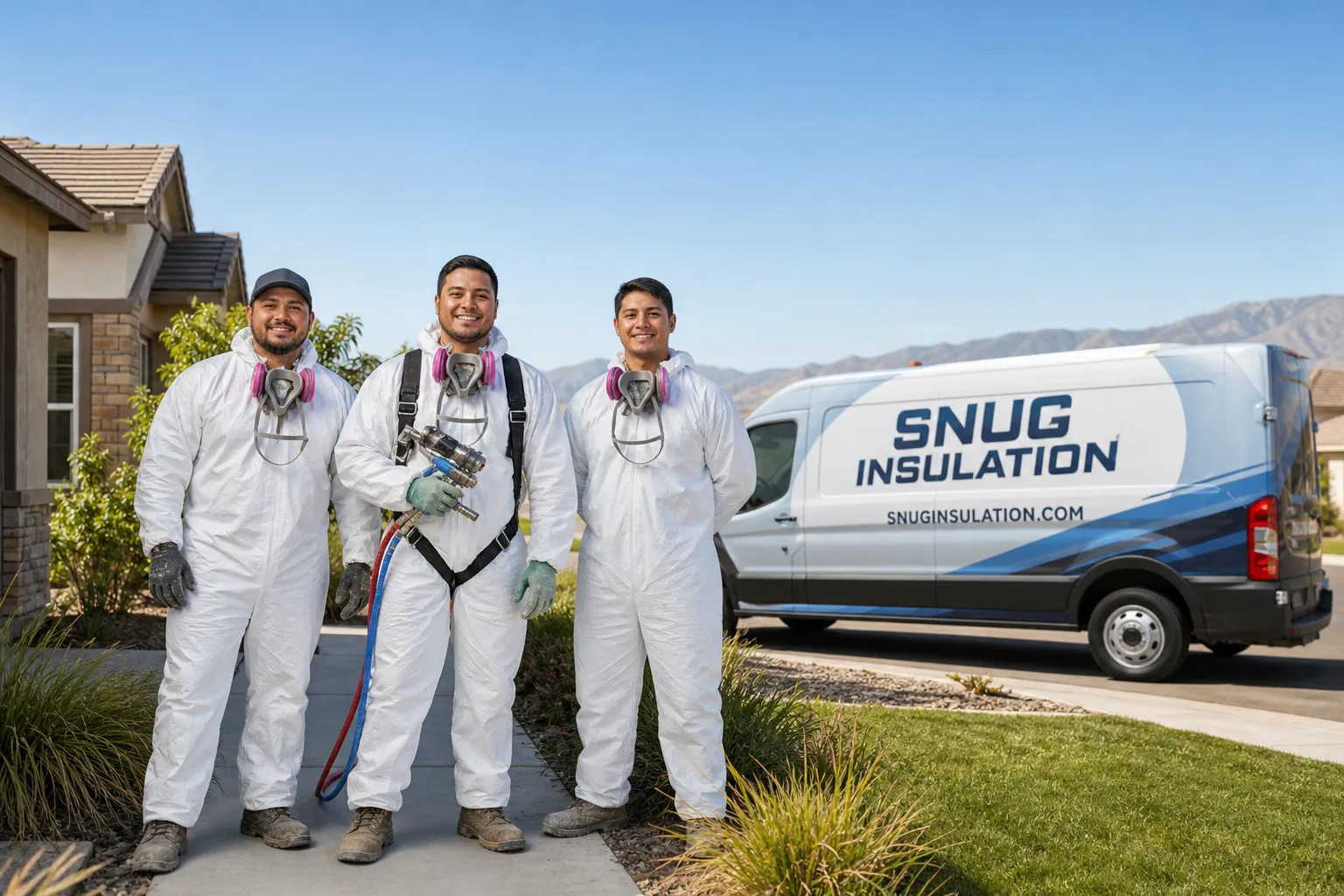
We also show up when we say we will. Yucca Valley is a regular route for our crews. We schedule jobs back to back to keep material costs down and response times short. And because Noel personally trains every technician, you get the same standard of work whether we’re sealing a 1970s ranch on a pier-and-beam foundation or a new custom home off Aberdeen Drive.
Attic Ventilation in Yucca Valley
Attic Ventilation in Yucca Valley is about letting the desert’s extreme heat escape before it cooks your insulation and your ductwork. In a properly ventilated attic, outside air moves through soffit vents, across the underside of the roof deck, and out through ridge or gable vents. That airflow keeps attic temperatures lower in summer, reduces moisture buildup in winter, and extends the life of whatever insulation sits below it. Most homes we see need both a ventilation correction and a thermal upgrade, because the two only work well together.
We typically recommend attic ventilation work when a home has bathroom fans venting into the attic, visible rust or dark staining on the sheathing, or an attic that feels 30 degrees hotter than the outside air on a summer afternoon. Homes built in the 1950s through the 1980s often have fewer than half the required soffit vents, and many have none at all. Adding a balanced system and pairing it with an attic insulation upgrade is one of the highest-payoff improvements you can make in Yucca Valley.
Signs Your Attic Needs More Airflow
The most common sign is a bedroom that stays hot long after sunset. Heat trapped in the attic radiates down through the ceiling for hours. You may also see peeling paint at the eaves, warped shingles, or frost on the underside of the roof on cold mornings. If your AC runs constantly in July but the house still doesn’t cool below 80°F, restricted attic airflow is often part of the problem.
What a Ventilation Correction Involves
We start by calculating the attic’s square footage and measuring existing vent area against the 1:150 rule in the California building code. Then we cut in additional soffit vents, add rafter baffles so insulation doesn’t block airflow, and in many cases install a properly sized solar or wind-driven turbine. A typical attic ventilation package in Yucca Valley runs $600 – $1,800 depending on vent count and whether we’re adding a ridge vent to a re-roof. The cost drops noticeably when done alongside an insulation upgrade, since we’re already mobilizing a crew and equipment.
Radiant Barrier in Yucca Valley
Radiant Barrier in Yucca Valley is one of the most overlooked upgrades in the high desert, and it’s also one of the most effective. A radiant barrier is a reflective foil layer, typically stapled to the underside of the roof rafters, that reflects radiant heat before it ever reaches your insulation. In a climate where summer attic temperatures regularly hit 140°F or higher, blocking that heat at the source keeps the whole house cooler and reduces the load on your air conditioner.
We recommend radiant barrier for homes where ductwork runs through the attic and where the roof has direct southern or western exposure. In the older tracts off Highway 62 near the Joshua Tree border, many homes have blown-in insulation that has settled to R-11 or less with no radiant barrier at all. That combination is a recipe for $400 summer electric bills. Adding a foil barrier and bringing the attic up to R-38 typically cuts summer cooling costs by 20 – 30% in those homes.
How It Works
The foil reflects up to 97% of the sun’s radiant heat rather than letting it absorb into the insulation. That keeps the insulation surface temperature down, which means the air in your ducts stays cooler as it travels to the registers. On cold nights, the barrier also helps retain heat by reflecting warmth back into the living space below.
What a Radiant Barrier Installation Costs
For a typical single-story Yucca Valley home, a radiant barrier installation runs $900 – $2,200 based on attic square footage and accessibility. It can be installed as a standalone job or combined with an insulation top-up to maximize savings. We find the combined approach works best in older ranches, where the dead air pocket created by the barrier adds to the thermal performance of fresh insulation. We can give you an exact quote by measuring your attic floor and rafter spacing, usually in under an hour.
Trusted Brands We Service in Yucca Valley
We insulate with Rockwool mineral wool in attics that need fire resistance and moisture tolerance, CertainTeed and Johns Manville fiberglass for standard batt and top-up work, and Knauf where budget and performance need to line up. Because we maintain deep local stock, a homeowner in Yucca Valley doesn’t wait on a supplier backorder when they schedule an installation. We pull and load materials in our own yard, which means we can often schedule a full attic upgrade within the same week. For custom homes with specific thermal or acoustic targets, Noel Castaneda personally matches the material spec to the house’s orientation, roof pitch, and duct layout. That’s the difference between a contractor who installs whatever rolls off the truck and one who treats your attic like a system.
Common Attic Insulation Problems We See in Yucca Valley Homes
- Settled blown-in at R-11 or less. In mid-century ranch attics off Highway 62, original cellulose or fiberglass blow-in has often compressed to half its intended depth. That’s roughly one-third the insulation value a high-desert home needs, and it shows up as wild temperature swings between rooms.
- No radiant barrier over exposed ductwork. Duct runs in unconditioned attics bake in summer and bleed heat on winter nights. If your registers blow warm air in July even with the AC set at 72°F, this is often the culprit.
- Unsealed air leaks around top plates, can lights, and plumbing chases. A 100°F attic pours conditioned air out of the living space through any unsealed penetration. We use expanding foam and caulk on every top plate seam and can light frame before insulation goes back in.
- Missing or crushed rafter baffles. In older Yucca Valley homes, soffit vents are often blocked by insulation shoved tight against the roof deck. That chokes attic ventilation and traps heat and moisture. Replacing baffles is cheap insurance against sheathing rot and summer heat buildup.
We recently worked a mid-century single-story ranch off Highway 62 near the Joshua Tree border where the original blow-in had settled to roughly R-11 with no radiant barrier over the exposed attic ductwork. The homeowner had upgraded to a smart-home-integrated HVAC system and wanted quiet, precise temperature control through the desert’s daily swings. We air-sealed the top plates and duct penetrations, installed a foil radiant barrier, and brought the attic up to R-38 with blown-in insulation. The result: a quieter, more stable indoor temperature pattern and the 20 – 30% summer cooling-cost reduction we expected for that tract’s stock.
Pricing for Attic Insulation in Yucca Valley, CA
A standard attic insulation top-up in Yucca Valley runs $1,200 – $2,600 for most single-story homes, while a full replacement including air sealing and rafter baffles lands between $2,400 and $4,200. Attic batt insulation for new construction or exposed framing runs $1,800 – $3,500 depending on square footage and whether we’re working around existing electrical and ductwork. Blown-in insulation is the most common choice here for its speed and coverage quality. Adding a radiant barrier typically adds $900 – $2,200 to the job. The biggest cost drivers are attic accessibility, the amount of old material that needs removal, and whether the ductwork needs to be lifted or worked around. Every quote is free, and we never pressure you into more than the house needs.
Noel Castaneda and the team at Snug Insulation are glad to price a job specifically to your attic’s square footage and current condition. Call (844) 241-0737 and we’ll walk the attic with you, show you photos of what we see, and give you a written number before we start.
We Also Serve Cities Near Yucca Valley
Our crews work throughout the Morongo Basin. In addition to Yucca Valley, we regularly serve homeowners in Morongo Valley, Desert Edge, Desert Hot Springs, and Garnet. If you’re in any of those communities and want the same material-matched approach to Attic Insulation, call us for a free estimate. We schedule by route to keep response times short and costs down.
Serving Yucca Valley, CA — Our Local Coverage Area
We’re based in the Yucca Valley area and know this community well. Use the map below to see our service coverage — if you’re nearby, we can almost certainly help.
FAQs About Attic Insulation in Yucca Valley
Because the original blow-in was never enough, and 30 years of high-desert heat cycles have settled it flat. We routinely find R-11 or less in attics off Highway 62 near the Joshua Tree border, when a home in this climate should be carrying R-38 minimum. The fix is a top-up with new blown-in material plus a foil radiant barrier, which together hold up to the daily temperature swings far better than the original install ever did. Call (844) 241-0737 and we’ll inspect for free.
Realistically, 20 – 30% in the older tract homes without radiant barriers. It depends on your current insulation level, duct condition, and shading, but upgrading from R-11 to R-38 with air sealing and a barrier consistently drops summer cooling costs by a quarter to a third in the homes we work on. The savings hold up year after year, unlike duct tape fixes or thermostat tricks.
A radiant barrier and a ventilation correction. When the slab is insulated but the ducts run through an unconditioned attic with no barrier, the AC system is fighting itself: the slab holds the cool air in, but the ducts heat it back up before it reaches the registers. We install foil barrier at the rafters, add soffit ventilation, and air-seal the duct penetrations so the air arrives at the temperature it left the coil. The difference is noticeable within a day or two.
Yes, and it helps in two directions. In summer, balanced airflow keeps the attic closer to outside air temperature rather than 40 degrees hotter, which reduces the heat load on your ductwork and insulation. In winter, it prevents the moisture buildup that leads to sheathing rot and mold. Most pier-and-beam ranches in Yucca Valley have less than half the soffit vent area they need, so adding vents and baffles is a straightforward and relatively low-cost fix.
We install blown-in fiberglass and cellulose, fiberglass batts from Knauf and CertainTeed, and Rockwool mineral wool batts for attics that need fire resistance or extra moisture tolerance. The material we recommend depends on the house, not on what we have in stock. For most retrofits in Yucca Valley, blown-in fiberglass or cellulose at R-38 with air sealing delivers the best cost-to-performance ratio, but older homes with specific fire-safety concerns or custom builds with acoustic targets often do better with mineral wool. Noel Castaneda can explain the trade-offs straight, and estimates are always free.
If your attic hasn’t been touched in years, don’t wait for another 100°F summer to prove it. Call Snug Insulation at (844) 241-0737 for a free attic inspection and an honest recommendation for your Yucca Valley home.
Written by Noel Castaneda, Owner at Snug Insulation, serving Yucca Valley and the Morongo Basin.