
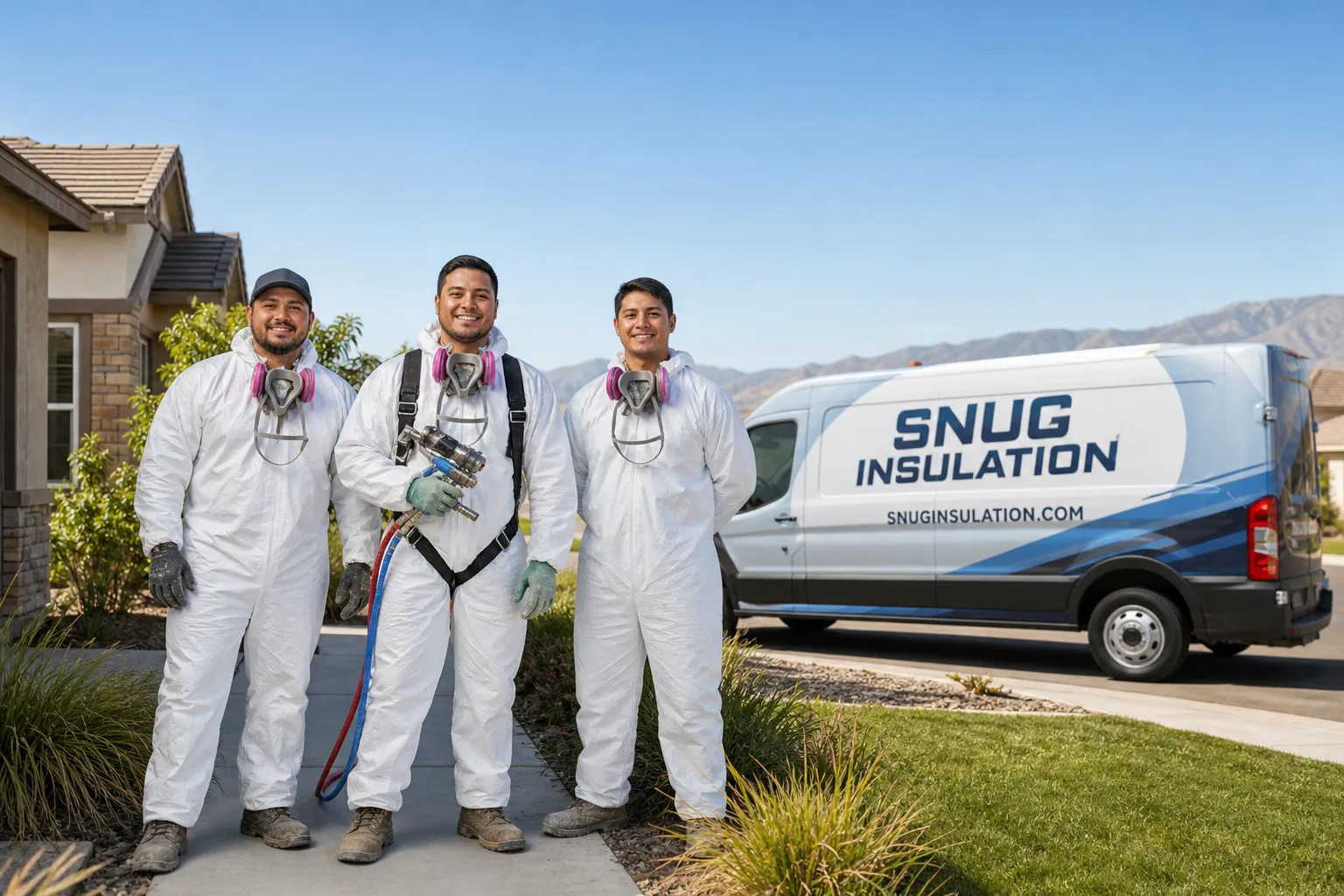
Fast, Reliable Attic Insulation Across Mayflower Village
Most homes in Mayflower Village are running on a thin, settled layer of 1950s rock wool, and every summer afternoon the roofs bake. That’s why attic insulation in Mayflower Village means something specific: cooling-load reduction, not heating retention. We’re Snug Insulation, and we work these unincorporated San Gabriel Valley streets every week, so the LA County permit path, the shallow ranch attics, and the old wiring are all familiar ground. Call (844) 241-0737 and we’ll get eyes on your attic, usually within one or two days.
What makes this corner of the 91006 zip different is that nothing is new construction. The homes are 1940s to 1960s single-story ranches and cottages on tight lots. Original plaster walls. Early Romex or knob-and-tube. And attics that were never built with real insulation in mind. So the work here is top-ups, radiant barriers, and ventilation retrofits, done around wiring that a generalist would rather not touch. We’re the specialist who touches it every day.
Why Snug Insulation Is Mayflower Village’s Preferred Attic Insulation Company
Our crews know the difference between a Monrovia roof pitch and a Mayflower Village shallow deck, because we drive these streets constantly. When a homeowner off Alhambra Road calls about rooms that hit 90 degrees by 3 p.m., we already know what we’ll find before we open the hatch: settled rock wool, a low attic, and wiring run everywhere. That local familiarity means fewer surprises and faster diagnoses.
Mayflower Village homeowners tend to be self-reliant people. They don’t want three visits and a stack of change orders. They want the job diagnosed correctly the first time, the right material prescribed, and the crew in and out clean. That’s exactly how Mayflower Village customers describe working with us, and why we get repeat calls from neighbors on Cloverly Avenue and Live Oak Avenue.
Noel Castaneda leads our crews, and he’s built the team around one discipline: insulation. Not roofing, not handyman work, not whatever the truck is already carrying. When we tell a Mayflower Village homeowner they need blow-in cellulose instead of batts, it’s because the attic access, the wiring clutter, and the county inspection path all point that way, not because it’s what we happen to stock.
The brand lineup matters here too. Owens Corning, Johns Manville, Knauf, and GreenFiber give us real material choice, and Rockwool mineral wool lets us offer something most local installers don’t even carry. For Mayflower Village’s fire-conscious homeowners near the foothill brush zones, that’s a meaningful option. Our Attic Insulation team carries the right product for each zone, not one product for every zone.
Attic Ventilation in Mayflower Village
Attic Ventilation in Mayflower Village isn’t a luxury add-on. It’s the first line of defense in homes where the roof deck heats to 140 degrees and radiates downward into living space, and ventilation retrofits here are typically sized to reduce that radiant heat load before insulation can do its job. A typical attic ventilation job in Mayflower Village runs $350 to $750, with the actual number depending on the attic size and how many existing vents are still open. Homes along Buena Vista Street and Edwards Place often need the full treatment: new soffit vents, added ridge or static ventilation, and confirmed air movement from eaves to peak.
The unincorporated status changes nothing about how heat loads the envelope, but it does change the inspection conversation. LA County Building & Safety reviews ventilation changes as part of a broader retrofit permit, which is a different path than the city processes in Arcadia or Monrovia. We know that path and file accordingly.
Signs Your Attic Needs Better Airflow
A Mayflower Village attic should feel hot but moving. If it feels stagnant, or if the second-half heat of summer turns upstairs rooms into ovens by mid-afternoon, the vents are failing. Peeling paint at soffits and visible moisture staining near the gable ends are the same story told twice.
Ridge, Soffit, or Static: What Fits a Mid-Century Ranch
On these tight-lot ranches, the original venting was often just a pair of small gable louvers. We typically add soffit vents and a continuous ridge vent for crossflow, or upgrade to larger static roof vents where the ridge line is short. The goal is matched intake and exhaust, not just more holes in the roof.
Radiant Barrier in Mayflower Village
Radiant Barrier in Mayflower Village is one of the highest-per-dollar upgrades we do, because the homes here are built for shade that no longer exists and the attics radiate heat straight down through original plaster ceilings. For homeowners also considering Reflectix service in Mayflower Village, we can discuss how it compares for your specific roof geometry. A typical radiant barrier install in Mayflower Village runs $350 to $650, depending on attic footprint and how many roof planes need coverage. On a clear 95-degree afternoon, the underside of the roof deck here exceeds 140 degrees; a radiant barrier drops that by 30 to 40 degrees, which is the difference between comfort and a ceiling you can feel radiating on you.
If the attic has room to walk a seam and the deck is standard framing, the install is usually a single-trip job. The county permit route matters here: a radiant barrier is a building-envelope change, and LA County has specific expectations about ventilation integration that a city crew might not know.
Radiant Barrier on Original Plaster Ceilings
One thing we’d never do is staple a barrier directly over knob-and-tube. On original plaster with ungrounded circuits, we mind the framing and use plastic-cap staples, and we’ll tell you honestly whether the benefit justifies the cost. On a low attic, sometimes a top-up is the better first move.
Backing Up the Barrier With a Top-Up
Radiant barrier controls the sun; insulation controls the air temperature. Mayflower Village homes need both. If the attic has settled rock wool under a radiant barrier, the ceiling still loses the cooling fight on a long July run. We’ll price the combination transparently.
Trusted Brands We Service in Mayflower Village
In Mayflower Village we stock and service Owens Corning fiberglass batts, Johns Manville performance batts, Knauf rolls, and GreenFiber cellulose, with Rockwool mineral wool available by quick order for fire-conscious or sound-sensitive homes. These aren’t brands we guess at; they’re in our local inventory pipeline, and when a Mayflower Village home needs an addition to match existing product, we can usually turn it around same week. Our pickup and supply runs cover Arcadia, Monrovia, Sierra Madre, and North El Monte, but Mayflower Village is in the regular loop, not an afterthought run.
Common Attic Insulation Problems We See in Mayflower Village Homes
- Settled rock wool mistaken for full insulation: Many of these 1940s to 1960s ranches have an original inch or two of rock wool that looks like more from the hatch. It’s not. Our crew sees it weekly on homes near Mayflower Avenue, and the rooms above stay hot every summer until the top-up happens.
- Knob-and-tube and early Romex crisscrossing the attic deck: The original wiring in these homes runs everywhere, and careless insulation work on top of it creates a heat trap that can degrade old insulation on the wire. We insulate around it, not over it, and we flag any damaged runs before the county inspector arrives.
- Shallow attic decks that defeat batt installs: Many Mayflower Village attics are so low and joist-crowded that batts don’t fit the way they should. Blown-in cellulose gets full coverage without wrestling a batt into a space that wasn’t framed for one.
- Unpermitted retrofits left behind by previous owners: More than once we’ve opened a hatch to find a DIY stapled foil job the county never saw. It’s not our place to be the enforcement arm, but we’ll tell you what’s there and what LA County will want to see before any new envelope work.
Pricing for Attic Insulation in Mayflower Village, CA
Attic Insulation in Mayflower Village typically runs $1,200 to $3,800, depending on the size of the ranch and what’s already up there. A basic top-up of GreenFiber cellulose over settled rock wool runs $1,000 to $1,800. A full air-seal and attic replacement with ventilation on a larger lot on Buena Vista Street can push past $3,500. Radiant barrier add-ons land around $350 to $650, and ventilation work sits at $350 to $750. The honest answer is that an older Mayflower Village ranch with knob-and-tube and a shallow deck costs more to do right than a 1990s tract home in Arcadia with a full-height attic. Call (844) 241-0737 and we’ll give you a straight quote.
Estimates are free. We don’t charge for a diagnosis, and we’ll tell you if a top-up solves the problem versus a full replacement. You won’t get a number dangled and then padded; you’ll get a canopy-level plan and a line-item price. That’s how Noel Castaneda’s crews have always worked these neighborhoods.
We Also Serve Cities Near Mayflower Village
Our regular route covers the 91006 zip and the surrounding San Gabriel Valley: Arcadia, Monrovia, Sierra Madre, and North El Monte. So if you’re calling from just over the county line in Monrovia or up in Sierra Madre, the response time doesn’t stretch. We stage our materials to run all these streets in a single day.
Serving Mayflower Village, CA — Our Local Coverage Area
We’re based in the Mayflower Village area and know this community well. Use the map below to see our service coverage — if you’re nearby, we can almost certainly help.
FAQs About Attic Insulation in Mayflower Village
Yes, attic insulation and related envelope changes in Mayflower Village go through LA County Building & Safety, because the community is unincorporated. The county reviews thermal envelope work differently than a city like Arcadia would, and they’ll want to see ventilation in place before the final sign-off. Call (844) 241-0737 and we’ll walk you through the county’s path for your specific project.
For most Mayflower Village ranches, yes. A GreenFiber cellulose top-up over settled rock wool commonly brings the attic to a functional R-value for a fraction of what full removal costs. The top-up runs $1,000 to $1,800, and it’s the most common job we do on these streets. If the rock wool has moisture damage or pest activity, replacement becomes the safer choice, and we’ll tell you that plainly.
Yes, because Mayflower Village’s summer afternoons routinely push past 95 degrees and the roof decks bake, which is a radiant-heat problem first and an air-temperature problem second. A radiant barrier drops the deck temperature by 30 to 40 degrees, and that heat never reaches the plaster ceilings. It works best paired with a top-up or proper ventilation, and we install it leaving the required air gap.
We can and do. Our crews know these shallow mid-century attics well enough to work around original wiring without mounding insulation over it, which is a heat-trap risk. If we see exposed, brittle, or damaged runs, we’ll stop and flag them before we bury anything. That’s the safe way, and the county inspector will expect it.
We carry Owens Corning, Johns Manville, Knauf, and GreenFiber on hand, with Rockwool mineral wool available by quick order. That means a Mayflower Village install rarely needs a second trip for materials. Call (844) 241-0737 and we’ll match the right product to your attic’s condition and your budget.
If your Mayflower Village attic has settled rock wool, shallow deck space, or old wiring, or if the upstairs rooms bake every summer, we’re the ones to call. Noel Castaneda and the Attic Insulation crew know these unincorporated streets, the county’s process, and the building stock. Call (844) 241-0737 for a free estimate and a straight answer.
Written by Noel Castaneda, Owner at Snug Insulation, serving Mayflower Village and the San Gabriel Valley.