Why Romoland Homeowners Choose Reflectix Insulation
We provide independent Reflectix insulation installation, repair, and replacement service across Romoland and the wider Perris Valley, with a focus on radiant barrier and reflective insulation done right for Riverside County’s summer heat. If you need Reflectix service in Moreno Valley, we handle that too. What sets our Reflectix work apart is that we treat it as a system component, not a miracle product: we match perforated versus non-perforated rolls to the actual application, enforce the air gap Reflectix performance depends on, and tell you plainly when blown-in or batt insulation will do more for your cooling bill than another layer of foil. If you’re dealing with a baked attic, sagging garage foil, or a crawl space that won’t dry out, call (844) 241-0737 for a free estimate.
Snug Insulation is an independent Reflectix service provider. We are not affiliated with or authorized by Reflectix, and we don’t pretend to be. What we are is a trade-focused insulation specialist that has installed, corrected, and torn out Reflectix products across Romoland’s mix of ranch homes, semi-rural parcels, and 1990s – 2000s tract subdivisions, so we know how the foil actually behaves here versus how it was marketed. We also provide Reflectix service in March Air Force Base. Noel Castaneda runs the crew, and his standard is simple: if we wouldn’t put the same material in our own attic, we won’t recommend it for yours.
Why Trust Snug Insulation for Your Reflectix Insulation?
Reflectix is a specific kind of product. It’s not fiberglass, it’s not foam, and it fails in predictable ways when it’s installed like either of those. Most generalist contractors treat the foil as a one-size roll-and-staple job and walk away. Our crew reads Reflectix’s own installation guidance, then reconciles it with what we see inside Romoland attics every week: 140°F-plus roof decks, low-pitch tile roofs with tight eaves, and framing that rarely matches the clean diagrams in a product brochure.
Noel Castaneda, owner at Snug Insulation, grew up in Costa Mesa’s Westside neighborhood and spent the better part of two decades doing hands-on insulation work before starting Snug. He’s the kind of contractor who will tell you a $40 roll of perforated foil is the right call on one job and a waste of money on the next. When we evaluate a Reflectix application in Romoland, we’re checking three things: is the foil positioned to actually reject radiant heat, is the vapor-permeability right for the assembly, and will the seams and staples hold up under Inland Empire temperature swings. If the answer to any of those is no, we say so and give you the fix that makes sense.
Common Reflectix Insulation Problems We Fix in Romoland
These are the failure modes we see most often in Romoland attics, garages, and crawl spaces. They’re not hypotheticals. They’re what we’ve physically pulled out of homes across the 92585 ZIP code.
- Reflectix Double Reflective Insulation Roll stapled tight to roof sheathing with no air gap. This is the single most common installation error in Romoland. Radiant barrier works by reflecting infrared heat across an air space. Pressed flat against the sheathing, the foil conducts heat into the attic instead of rejecting it. We re-run the foil across the underside of the rafters with the required gap, or we pull it and install a perforated radiant barrier on the attic floor where it actually does its job.
- Non-perforated Reflectix used as a crawl space vapor barrier. Non-perforated bubble foil traps moisture. In Romoland’s low-humidity climate that sounds harmless, but the soil under a raised foundation still releases vapor, and once that vapor gets behind non-perforated foil stapled to floor joists, it condenses and sits against wood. We replace it with perforated product or a proper six-mil poly ground barrier, depending on the situation.
- Dust-matted and sun-degraded foil in open garages and detached shops. Reflectix foil loses its reflectivity when it’s coated with dust or exposed to direct sunlight. In Romoland’s dry, dusty air, this degradation happens faster than most homeowners expect. When the reflective surface dulls, the product stops rejecting heat and starts simply trapping it. We clean what’s salvageable and replace what isn’t.
- Stapled seam and tape failures on radiant barrier runs. Reflectix seam tape cracks and peels under attic heat cycles. Staples pull out of old framing when the wood dries out. Gaps open between foil runs, and radiant heat shoots straight through the openings. We re-secure runs with proper staples and compatible foil tape, then verify every seam is actually sealed before we leave.
- Foil crushed between joists or trusses. When Reflectix gets compressed, the bubble core collapses and the foil loses what little insulative value it had. This happens when someone shoved batts on top of foil, or when the foil was laid across joists and then loaded with stored boxes. Crushed Reflectix goes in the bin, not back on the ceiling.
Reflectix Parts & Our Repair-vs-Replace Approach
We source genuine Reflectix rolls and panels when a Romoland homeowner wants to continue the brand’s product, which is most common on garage ceilings and HVAC duct wraps where the foil’s reflectivity is the primary feature. For Reflectix repair in Woodcrest, we bring the same approach. That includes Reflectix Double Reflective Insulation, Reflectix R-8 HVAC Duct Insulation wrap, and Reflectix Reflective Foam Core panels. We also keep reputable foil-faced and bubble radiant barrier equivalents on hand for situations where a full run doesn’t justify brand-name cost, and we’ll tell you the price difference up front so you can decide.
The repair-versus-replace call comes down to this: if the foil still reflects, the seams are intact, and the air gap is right, we repair. If the foil is degraded, torn, or installed wrong in the first place, pulling it and doing it correctly is usually cheaper in the long run than patching. And Reflectix in Colton follows the same pattern: in most attics, it’s a supplement, not a substitute, for blown-in R-value. When topping up fiberglass is the smarter spend than layering more foil, we say that out loud. Call (844) 241-0737 and we’ll give you an honest take.
Our Reflectix Service Process – Step by Step
- 1
Diagnosis. We inspect the attic, garage, or crawl space and measure actual temperatures and moisture conditions. For Reflectix specifically, we check the air gap, the perforation type, and the condition of every seam and staple run. A foil assembly that looks fine from the hatch can be dead from dust or crushing.
- 2
Plan. We match the right Reflectix product to the assembly. That means perforated radiant barrier for attic floor and roof-deck applications where vapor needs to pass, non-perforated for specific duct and wall cavity uses where the foil is deliberately acting as a vapor barrier, and Reflective Foam Core panels where the job calls for a semi-rigid panel with higher R-value.
- 3
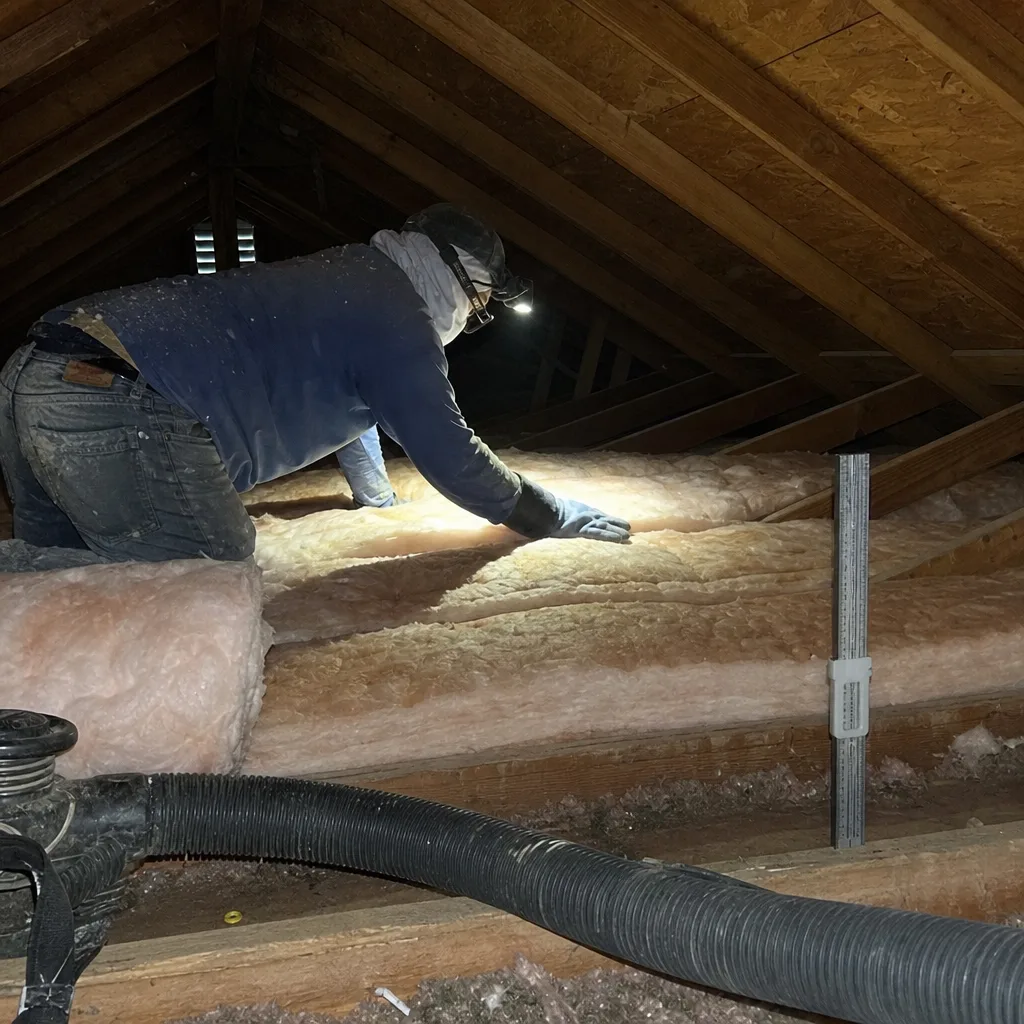
Install or repair. We install with the correct air gap, the correct fasteners, and compatible foil tape on every seam. In Romoland attics we typically schedule work at dawn because roof decks are already cooking by mid-morning from late spring through early fall, and we work in sections so the foil doesn’t sit in direct sun while we handle it.
- 4
Test. We verify seam integrity with a visual and touch pass across every run, check the air gap with a probe, and inspect the surrounding assembly for gaps that would undo the foil’s performance. On radiant barrier jobs we’ll often measure attic surface temps before and after to show you the actual drop.
- 5
Warranty-safe closeout. We document what was installed, where, and in what condition. No manufacturer of any product we handle will honor a warranty on incorrectly installed material, so we make sure the work matches the written guidance before we call it done.
Reflectix Products We Service & Install in Romoland
We work with the full Reflectix residential product line that’s actually relevant to Inland Empire homes. That includes the Double Reflective Insulation roll, the perforated Double Reflective Foil Radiant Barrier with staple tabs, the R-8 HVAC Duct Insulation wrap for exposed duct runs in hot garages and attics, the Reflective Foam Core panels in R-3 through R-8 ratings, and the R-21 Attic Floor Insulation product where a perforated foil radiant barrier belongs. We keep rolls and seam tape stocked locally in Romoland so most repairs and smaller installs can happen same week without waiting on a parts order from the coast.
We Also Service These Brands
Reflectix is one tool in a bigger kit. We also install Owens Corning, Johns Manville, CertainTeed, and Knauf fiberglass, Rockwool mineral wool, Icynene and Demilec spray foam, and GreenFiber blown-in cellulose. That matters because the right answer for a Romoland attic is rarely a single product. It’s a combination, and we stock enough of the lineup to build that combination without starting a religious war over one brand.
FAQs – Reflectix Insulation Service in Romoland
No. We are an independent insulation contractor, not a Reflectix dealer or authorized service provider. We source genuine Reflectix products through standard distribution channels and install them according to the manufacturer’s published guidance, but Reflectix does not endorse or authorize our work. We’d rather be straight about that than pretend otherwise.
Yes, but only when it’s used as a radiant barrier with the required air gap and paired with bulk insulation. Reflectix foil rejects radiant heat, which is the dominant heat-transfer mode in a Romoland attic with a 140°F roof deck. But foil alone, with no air space, does almost nothing. And foil without adequate blown-in or batt insulation underneath doesn’t solve the full heat-load problem. In a Romoland attic, the right setup is typically blown-in fiberglass at proper R-value under a properly installed perforated radiant barrier. Call (844) 241-0737 if you want us to look at what you have now.
Perforated Reflectix, never non-perforated, if you’re installing foil under the floor joists. Non-perforated foil acts as a vapor barrier, and in a Romoland crawl space that traps moisture against the wood framing. If the goal is actually blocking ground vapor, the better approach is a six-mil poly barrier laid over the soil, with perforated foil above it only if you’re specifically trying to add a radiant component at the floor. We can inspect your crawl space and tell you which product belongs there.
Sagging usually means the staples pulled out or the roll was installed with too few fasteners per linear foot. It can also be a sign the foil was stretched tight across a space that flexes with temperature swings, which is every exposed garage in Romoland from June through October. Sagging foil loses its air gap and tears along the staple lines. The fix is re-securing with correct spacing and adding washers at the staple points, or re-running the sections that are too damaged to hold up. For an exact quote, call (844) 241-0737.
Only if it’s a perforated product. The perforations let moisture pass through so you don’t trap vapor inside the fiberglass or cellulose below. Non-perforated foil over attic floor insulation is exactly how you create a hidden moisture problem in a Romoland attic. But there’s a bigger issue: radiant barrier on an attic floor collects dust, and once it’s coated, its reflectivity drops sharply. In our experience, many Romoland attics are better served by adding more blown-in insulation than by laying foil on top of old batts. We’ll tell you which applies in your case.
It can, as part of a properly designed assembly. A correctly installed radiant barrier cuts the peak attic temperature, which reduces the heat load on the ceiling below, which means your AC runs less during Romoland’s hot afternoons. But radiant barrier alone, with no bulk insulation behind it, won’t produce the savings most homeowners expect. The order of operations in this climate is: air seal the ceiling plane, reach proper blown-in R-value, then add the radiant barrier if the attic still needs it. Estimates are free. Call (844) 241-0737 and we’ll walk through the actual numbers for your house.
For radiant barrier installation, most Romoland homes run between $0.80 and $1.50 per square foot of installed surface, including materials and labor, with the exact price depending on attic access, rafter layout, and whether we’re re-running foil or installing it fresh. Repairs to existing Reflectix, like re-stapling sagging runs or patching torn sections, usually run $150 to $400. A full garage ceiling job with the Double Reflective roll typically lands in the $250 to $600 range depending on the size of the ceiling. Call (844) 241-0737 for an exact quote. Estimates are free.
Written by Noel Castaneda, Owner at Snug Insulation, serving Romoland and the Perris Valley.