
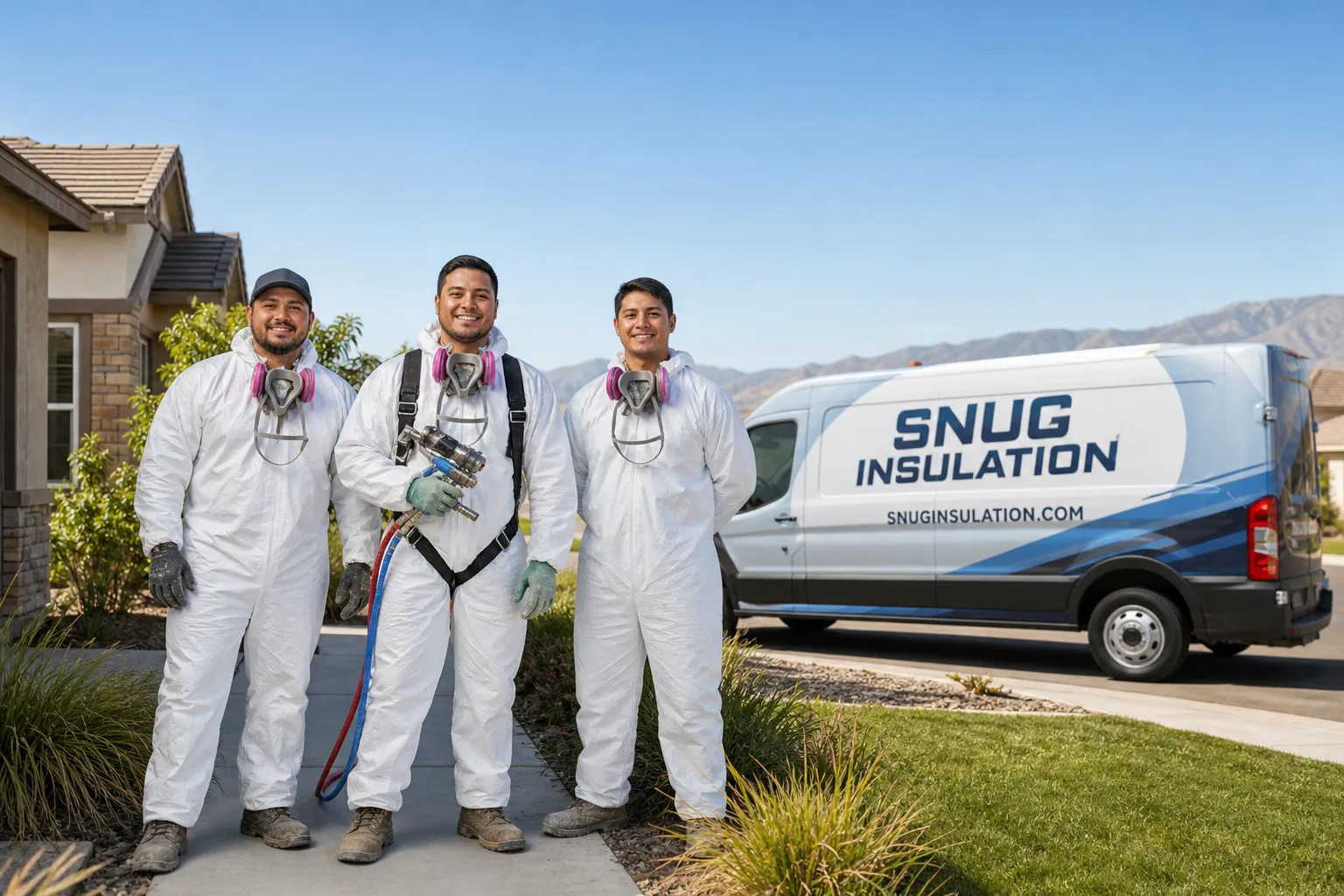
Fast, Reliable Attic Insulation Across Murrieta Hot Springs
Attic insulation in Murrieta Hot Springs typically runs $1,800 – $4,200 for a full top-up or replacement in an average 1,800 – 2,400 sq ft tract home, with radiant barrier adding roughly $900 – $1,800 depending on attic size. Most jobs here finish same-day or next-day. The inland valley heat is brutal on under-insulated attics, and we see it every week in 92563. Call (844) 241-0737 for a free estimate and we’ll come out, measure what’s actually up there, and give you a straight answer.
We know Murrieta Hot Springs homes because we work in them constantly. The stucco-and-tile planned communities off Clinton Keith Road and around the hot springs corridor have a specific set of problems you won’t find in older Riverside neighborhoods. More on that below.
Noel Castaneda, Owner at Snug Insulation, has built the company around one thing: sealing the envelope so your AC isn’t fighting a losing battle against a 150°F attic.
- Key takeaways: Most 92563 attics have settled builder-grade fiberglass running at half the R-value they should have.
- Tile roofs make attic access trickier here. Crews usually go through garage or closet scuttles, which adds labor and demands better air-sealing.
- Radiant barrier is not optional in Murrieta Hot Springs summers. It’s the difference between an attic that bakes and one that vents.
- We stock material from Johns Manville, Knauf, and Rockwool locally, so turnaround is fast.
Why Snug Insulation Is Murrieta Hot Springs’s Preferred Attic Insulation Company
Snug Insulation is a single-trade specialist. We don’t do roofing, we don’t do plumbing, we don’t do general contracting. We do attic insulation, spray foam, and blown-in insulation, and that focus means every technician who steps into a Murrieta Hot Springs home has spent their entire workweek solving thermal and air-sealing problems, not fitting it in between other jobs.
What that looks like for you: We roll up to a tract home off Murrieta Hot Springs Road, and we already know what we’re going to find. Builder-grade R-13 batts in the walls. Settled blown fiberglass in the attic that’s lost a third or more of its original loft. Recessed light fixtures leaking conditioned air into the attic. A garage scuttle with no weatherstripping. We’ve seen it hundreds of times in 92563.
We work with eight insulation manufacturers, including Johns Manville, Knauf, and Rockwool. That matters because we’re not locked into whatever one brand happens to be cheapest that week. If your attic needs blown-in cellulose for even coverage around odd framing, we use GreenFiber. If you want mineral wool’s fire resistance and sound control in a specific wall cavity, we stock Rockwool. If a dense-pack fiberglass fill makes more sense for your budget, we can do that too. Material matching is the job.
Noel Castaneda runs every project with the same standard: the right material, the right method, and an attic that performs better the day we leave than the day we arrived.
Attic Ventilation in Murrieta Hot Springs
Attic Ventilation in Murrieta Hot Springs isn’t a nice-to-have; it’s the difference between an attic that runs hot enough to shorten your AC’s life and one that stays within a reasonable range all summer. We see attic temperatures spike past 150°F in July and August across 92563. Without proper airflow, that heat sits up there and radiates down into your living space all night.
Here’s what the job involves: we assess your existing soffit vents, ridge vents, and any gable vents, then we calculate the Net Free Vent Area (NFVA) your attic actually needs based on its square footage. Most 1990s – 2000s tract homes in Murrieta Hot Springs were built with marginal ventilation because the builder was trimming costs. Twenty-plus years later, those soffit vents are often painted shut, clogged with dust, or blocked by over-zealous insulation work from a previous contractor.
A typical attic ventilation upgrade in Murrieta Hot Springs runs $450 – $1,200 depending on the number of vents, the attic geometry, and whether we need to add baffles or unblock existing soffits. It’s usually done in one day.
Tile Roof Ventilation Constraints
Terracotta tile roofs dominate 92563. They’re durable and they look right for the area, but they make adding roof-mounted vents more labor-intensive. Pulling tiles is risky for the roof and expensive for you. In most cases, we can improve ventilation through existing ridge vents and soffit-side work without disturbing the tile at all.
When to Add Ventilation vs. Insulation
If your attic already has decent insulation depth but your upstairs still runs hot in the afternoon, ventilation is usually the missing piece. If you’re low on insulation, we fix that first, then size ventilation to match the sealed-and-fluffed attic after the insulation goes in. The two work together.
Radiant Barrier in Murrieta Hot Springs
Radiant Barrier in Murrieta Hot Springs is the single highest-impact upgrade you can make for summer comfort, because it attacks heat transfer directly rather than just slowing it down. A radiant barrier is a reflective foil installed on the underside of the roof decking that bounces radiant heat back out before it can load up your attic air and your insulation.
In a Murrieta Hot Springs attic that’s hitting 140 – 160°F in July, a properly installed radiant barrier can cut that temperature by 20 – 30°F. That’s not a marginal difference. That’s your AC running measurably less, your upstairs bedrooms finally holding 76°F, and your insulation degrading more slowly over time.
A radiant barrier install in Murrieta Hot Springs typically runs $900 – $1,800 for an average tract-home attic, including all labor and material. We install it as part of an insulation top-up or replacement, not as a standalone afterthought. Layering it with new blown-in insulation is almost always the smarter play than doing either one alone.
How Radiant Barrier Works with Tile Roofs
Terracotta tile actually helps here. Tile has some thermal mass and reflectivity of its own, but the air gap between the tile and the roof deck lets heat build up underneath. A radiant barrier on the decking under that air gap is exactly where it does the most good. We install it without pulling tiles, working from inside the attic.
Radiant Barrier vs. More Insulation
They solve different problems. More insulation slows conductive heat gain; a radiant barrier blocks radiant heat gain. In Murrieta Hot Springs summers, radiant heat is the dominant load, which is why we recommend the barrier first if you’re choosing between the two. But the best result comes from doing both, and we’ll tell you honestly if your budget says one now and one later.
Trusted Brands We Service in Murrieta Hot Springs
Snug Insulation installs materials from Johns Manville, Knauf, and Rockwool, among others. We choose the brand based on the job, not based on what’s left in the warehouse. For deep blown-in fills in Murrieta Hot Springs attics, we often run Johns Manville loose-fill fiberglass. For fire-rated and sound-dampening needs, Rockwool mineral wool is unmatched. For dense-pack and specific thermal targets, Knauf delivers. We hold local stock for 92563 jobs, which means we can typically start within a few days of your estimate, not two weeks out waiting on a distributor.
Common Attic Insulation Problems We See in Murrieta Hot Springs Homes
- Settled builder-grade blown fiberglass: Most 1990s – 2000s homes in 92563 left the builder with R-13 to R-19 worth of blown fiberglass. Twenty-plus years of gravity and heat cycling later, it’s often compressed to half that. The fix is a clean top-up or full replacement, not just more material dumped on top of the settled mess.
- 150°F+ attic temperatures baking the insulation: Inland Riverside County heat accelerates degradation. Insulation that’s been cooked at 150°F for a decade loses loft and R-value faster than the manufacturer’s spec sheet suggests. That’s a Murrieta Hot Springs reality, not a national average.
- Tile-roof access forcing bad retrofit work: Because crews often enter through garage or closet scuttles rather than pulling tiles, sloppy contractors leave gaps around the scuttle frame, around recessed fixtures, and around plumbing penetrations. Those gaps leak conditioned air into the attic, and they’re invisible from below. We air-seal every one of them.
- Cold-weather heat loss through the same attic: Winters here dip toward freezing, and the same under-insulated attic that cooks your house in July lets heat escape in January. Upstairs bedrooms run cold, the furnace cycles more, and nobody connects it to the attic. We do.
Pricing for Attic Insulation in Murrieta Hot Springs, CA
Here’s what you can expect to pay in this market, based on what we’re seeing in 92563 right now. A blown-in attic top-up to bring a settled attic back to current Title 24 levels runs $1,500 – $2,800. A full attic insulation replacement in a typical tract home runs $2,800 – $4,200. Radiant barrier adds $900 – $1,800. Attic ventilation work runs $450 – $1,200. The biggest cost factors are attic square footage, access difficulty (tile roofs and scuttle-only entry add labor), and whether we need to remove old material first. We give free estimates with a written price before any work starts. Call (844) 241-0737 to schedule yours.
We Also Serve Cities Near Murrieta Hot Springs
Snug Insulation covers the wider Temecula Valley and nearby Inland Empire communities. If you’re in Murrieta Hot Springs, you’re in our primary service area, but we also regularly work in Murrieta, Temecula, Wildomar, and Quail Valley. The same crew, the same pricing, the same material choices. See our full Attic Insulation service page for the complete scope of what we do.
Serving Murrieta Hot Springs, CA — Our Local Coverage Area
We’re based in the Murrieta Hot Springs area and know this community well. Use the map below to see our service coverage — if you’re nearby, we can almost certainly help.
FAQs About Attic Insulation in Murrieta Hot Springs
Probably not. Homes built in 92563 in the early 2000s typically left the builder with R-13 to R-19 blown fiberglass, and after 20+ years of settling and heat exposure, most attics we open are running at half that effective R-value. We can come out, measure your existing depth, and tell you exactly where you stand against current Title 24 targets. Call (844) 241-0737 for a free attic assessment.
Yes, on both counts. Tile roofs make roof-deck access more difficult, so most crews work through garage or closet scuttle holes, which adds labor time. They also trap heat under the tile-air-deck gap, which raises attic temperatures and puts more thermal stress on your insulation. Expect a 10 – 15% labor premium on a tile-roof Murrieta Hot Springs attic versus a shingle roof. We price it honestly up front.
Yes, and it’s usually the best per-dollar thermal upgrade you can make in Murrieta Hot Springs. A proper radiant barrier can cut attic temperatures by 20 – 30°F, which translates directly into lower AC runtimes and more stable upstairs temperatures. In this climate, we recommend it on nearly every full attic job. It’s around $900 – $1,800 and pays for itself faster here than almost anywhere in California.
Because their attic has been upgraded and yours hasn’t. Same builder plan means the same starting insulation, but if they’ve topped up to R-38+ and air-sealed their attic, the difference is night and day when nights drop toward freezing. It’s not a mystery; it’s a missing few hundred dollars of blown-in material. We can tell you what’s in your attic versus what your neighbor likely has after a visit.
You can, but only if the existing material is dry, clean, and not badly settled. If your current blown fiberglass has compressed to a dense mat, blowing over it doesn’t restore the air pockets that give it its R-value. That’s why our Attic Insulation team always evaluates the existing layer before recommending top-up versus removal-and-replacement. Call (844) 241-0737 and we’ll tell you which path makes sense for your attic.
In most cases, we can schedule same-week service in Murrieta Hot Springs, and for emergency situations like a completely failed attic seal or post-rain moisture concern, we’ll do our best to come same-day. Call (844) 241-0737 before noon and ask what slots are open.
Yes. We cover the entire 92563 ZIP, including the communities off Clinton Keith Road, Murrieta Hot Springs Road, Winchester Road, and the neighborhoods east of the 215 around Los Alamos Hills. If you’re anywhere in Murrieta Hot Springs, you’re in our service area.
Yes, our workmanship is backed through our company, and the materials we install carry their respective manufacturer warranties from Johns Manville, Knauf, Rockwool, and the other brands we use. We’ll give you the specifics in writing for your specific job before any work begins. Call (844) 241-0737 and we’ll walk you through it.
Pricing is essentially the same across the Temecula Valley. Murrieta Hot Springs tile-roof homes may carry a slightly higher labor line because of scuttle-only access and the care required around decking, but we don’t charge a different base rate for your ZIP versus Murrieta or Temecula. The free estimate we give you is the price.
We do full removal when the existing material is wet, pest-damaged, or so degraded that topping up won’t restore performance. Removal adds labor, but it’s sometimes the only way to start clean, air-seal properly, and install fresh material that performs. In 92563, the most common trigger for removal is rodent contamination or a past roof leak, not simple age. We’ll give you a straight read on whether removal is actually necessary or if a top-up gets you where you need to go.
Yes. Snug Insulation installs both open-cell and closed-cell spray foam using Icynene and Demilec systems, in addition to blown-in fiberglass and cellulose. Some Murrieta Hot Springs attics, especially those with complex rooflines or ducts in the attic, are better served by spray foam than by blown-in material. We’ll tell you honestly which approach fits your specific attic and why.
Yes, we install attic baffles and prep ventilation as part of our Attic Insulation work. If your soffit vents are blocked, we clear them and add baffles so insulation doesn’t choke airflow. It’s one of the most overlooked parts of a proper attic job in Murrieta Hot Springs, especially on older tile-roof homes where soffit airflow was never great to begin with.
We start with a free attic inspection, usually 30 – 45 minutes. We measure depth, check for moisture and pests, assess ventilation, and give you a written quote with material options and pricing. Once you approve, we schedule the work, typically within a week. Most jobs finish in one day. The crew air-seals first, installs baffles and a radiant barrier if specified, blows the material, and cleans up before they leave.
Call (844) 241-0737 and tell us you’re in Murrieta Hot Springs; we’ll get you on the schedule. We’ll confirm your address, set a visit window, and Noel or a senior tech will come out and give you the full readout. The estimate is free and there’s no obligation to book.
Why Your Murrieta Hot Springs Builder Cut Corners on the Attic
Here’s the thing about Murrieta Hot Springs’s housing stock that most insulation companies won’t tell you. The planned-community tract homes that fill 92563 were built in a boom period. They went up fast, and the attic was the easiest place for builders to save a buck. R-13 to R-19 blown fiberglass was code-compliant at the time, so that’s what went in. Nothing more. The builders weren’t thinking about what that attic would look like after 20 summers of 100°F+ heat and 20 winters where nights dip toward freezing.
We were in a tract home off the 92563 planned-community streets last summer, and the original blown fiberglass had settled to barely a third of the attic depth. Summer attic temps were already cooking past 150°F. Because the terracotta tile roof meant no safe tile-pull access, we worked through the garage scuttle to air-seal, then blew GreenFiber and added a Reflectix repair in Murrieta Hot Springs style radiant barrier to knock down the inland-valley heat load. The homeowner noticed the upstairs rooms finally held temperature through the 100°F+ afternoons. That’s not a magic trick. That’s just what happens when you put the right material in the right place and stop pretending builder-grade from 2003 is still doing its job.
And that’s the core issue: the geothermal history of the hot springs area means many of those early-2000s homes were built for thermal performance expectations that don’t match modern energy standards. The builders weren’t malicious. The standards were just lower then. But now you’re living with the results: upstairs rooms that won’t hold a set point in July, a furnace that runs all night in January, and an energy bill that keeps climbing. The fix is very straightforward. If you own one of these homes, call us before the next heat wave. The attic isn’t going to fix itself.
Written by Noel Castaneda, Owner at Snug Insulation, serving Murrieta Hot Springs since the company’s founding.